
Hi all! This is Ellen Huggins, JEC Archives Fellow. May 14th is Mother’s Day, and what better way to celebrate than with a brand new blog post? While working on the “Dining Services” page of the Women of Davidson college website, we came across several stories of “housemothers” from the early days of Patterson Court. Even though these women were not the actual mothers of the students they served (there might have been a few exceptions, who knows), we thought you would get a kick out of some (House)Mother’s Day Davidson history.
The post below is an excerpt from the History of Dining Services page of the “Women of Davidson” site, which you can view here: https://digitalprojects.davidson.edu/omeka/s/college-archives-women-of-davidson/page/dining-services-history. The site focuses not only housemothers, but on the untold history of cooks on Jackson Court and Patterson Court. We hope you can give it a read!
Starting in the 1860’s, one of the most common dining options for Davidson students was to eat at private boarding houses in the town of Davidson. These boarding houses were run by local women who formed lasting connections with the students that frequented their homes; below, a Davidson alum of the late 1800’s recounts the significant impact that Mrs. Barnes, who ran the Barnes’ Club eating house, had on the other students who stayed under her care.
His remembering of Mrs. Barnes reflects the beginnings of the important community and connection built by women who worked in Davidson College’s dining services.
“After staying with Mrs. Barnes for four years, eating her prepared food week by week and absorbing some of her steadfast upbuilding philosophy, they graduated feeling like a new born man literally as well as seeing the beauty in life, the dependability in others, and the beautiful world given to all of us to embody.”
– “Influence…,” Harris A. Johnson. The Mecklenburg Gazette, July 23, 1964
In response to the rising popularity of fraternities amongst Davidson students in the early 20th century, Jackson Court was created in 1928; a semi-circle of houses along Concord Road that were rented out to fraternity chapters for 500 dollars a month by Davidson College. Unlike the fraternities and eating houses of Davidson today, the Jackson Court houses were only meant as meeting places and had no dining facilities, meaning students still had to join local boarding houses to get their meals.
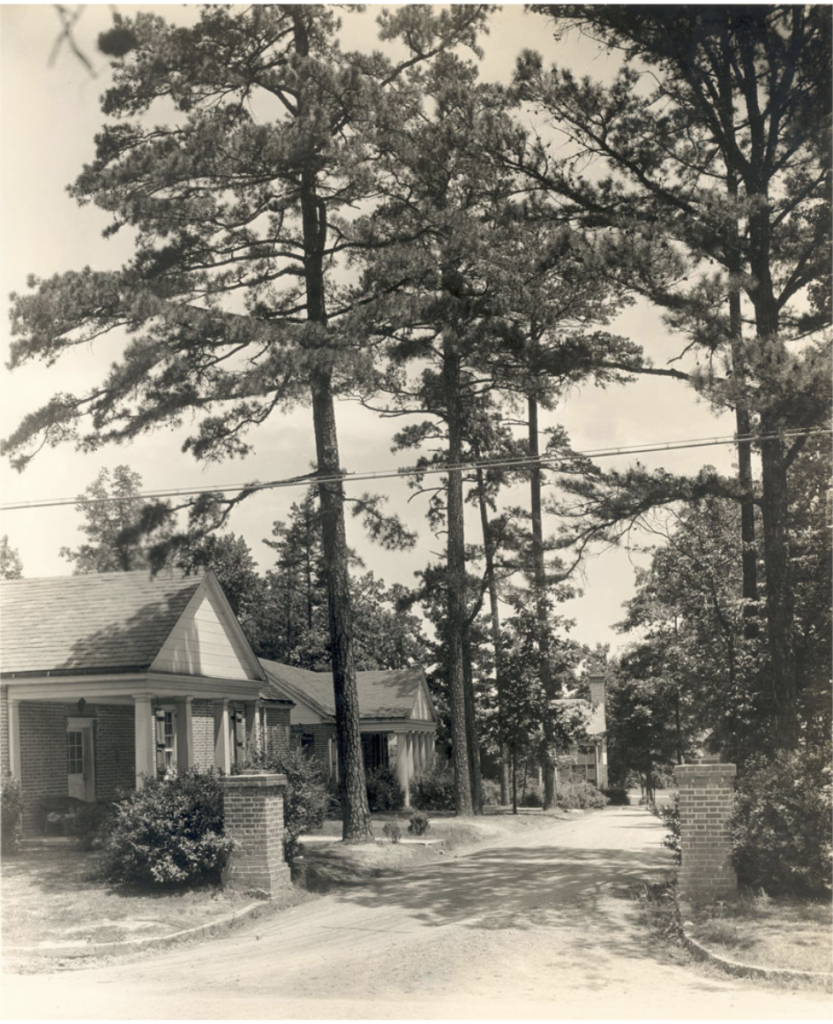
As more Davidson students belonging to fraternities matriculated into local boarding houses, certain houses in town became closely associated with specific fraternities. The women who ran these boarding houses used the kitchens and dining spaces of their own homes to serve fraternity members. Over the course of Jackson Court’s thirty years, these “boarding house women” became known as surrogate mother figures to Davidson students, setting the precedent for the housemother role to be introduced in the Patterson Court era.
Greek life began to move from Jackson Court to the new Patterson Court starting in 1958. As Patterson Court houses were built to include kitchens and dining facilities, each house hired its own housemother to plan the fraternity’s menus, assist in managing the house’s budget, and hire cooks to prepare meals. Another new feature of the Patterson Court houses were the inclusion of apartments for housemothers, where they would live year-round to monitor and facilitate fraternity activities.

Over the next decade, housemothers became significant figures in the everyday lives of Davidson students, taking up the mantle from the boarding house women of the past. This can be seen in the article from the Davidson College Bulletin below, which describes an honorary event thrown for housemother Johnsie Shelton, who served at the Pi Kappa Phi fraternity for over 10 years. Shelton had previously run a boarding house affiliated with the PKP fraternity and moved into the fraternity’s Patterson Court house upon its construction, further showing the close correlation between the housemother role and Davidson’s boarding house history.

“I still keep up with my boys,” says mother to generations of Davidson students, Miss Johnsie Shelton, who has been a guardian angel to Davidson College boys all her life. (…)
Her home on Concord Road was used as the boarding house for the fraternity until the new half million dollar Patterson Fraternity Court opened last year. When asked whether she would leave her home to live in the housemother’s apartment in the new fraternity house, Miss Shelton said, “You can’t put old wine in new bottles.” But she went anyway, and now the “old wine” feels much at home in the “new bottle.”
“My favorite subject right now is ‘what are ya goin’ to feed the boy’s?'”
“Her boys feel she has done more than feed them. This spring, the Pi Kappa Alpha Phi fraternity surprised her with “Miss Johnsie’s Appreciation Day.”
– “Johnsie Shelton Appreciation Day.” Davidson College Bulletin, August 1959.
The importance of housemothers in student life can also be seen through their numerous mentions in the Quips and Cranks yearbooks of the 1960’s. Below, the Phi Delta Theta fraternity dedicates a line of their 1960 yearbook page to “Mother Payne”; “[She] fed us well, helped us impress our dates, and was an excellent housemother.”

Mrs. J. Carey Stewart, housemother of the Alpha Tau Omega house, even reserved her own spot on a wooden paddle that was gifted from one fraternity member to another in 1961.

In the 1970’s, fraternity housemothers began to lose their once strong influence over student life; a Davidson College student life study from 1973 reported that five housemothers split their time between eight different fraternity houses, a far cry from the individualized attention given to each house by housemothers of the past. This came during a time of larger cultural changes at Davidson brought on by campus integration in 1963, coeducation in 1972, and other social movements that broadened perspectives of students, faculty and staff, and shifted the mission of Davidson College as a whole.
Davidson was no longer a school for exclusively male students to be molded into “Davidson Gentlemen” under the watchful eye of housemothers and guiding hand of college administration; instead, Davidson students of all genders desired more independence and freedom in their college experience, and this extended into their dining options. By the 1980’s, the housemother position had been phased out completely, but cooks remained and took on a more central role in the eating houses and fraternities of Patterson Court, becoming figureheads in their own right. (Refer to our previous blog post on Fannie and Mabel.)
Housemothers represent many of the complexities of Davidson’s history; they belong to an earlier version of campus that could be seen as quaint, tight knit and more nurturing to students than the Davidson College of today, or alternatively, a stuffy and restrictive past. What remains undisputed is that housemothers made a difference in the everyday lives of Davidson College students by helping to provide them with a warm meal and a space to enjoy it in, and that is a legacy worth celebrating.




![Interviewer: How did you end up at the Sunday school [at the mill chapel]?
Margaret Potts: Well I was teaching Sunday school in Davidson Presbyterian Church, early. They wanted me to have the little ones, the two in, whatever hours it was, babysitting more than anything else, in the old church. It was a terrible place to have little children. But anyway, so just through the years, I would teach Sunday school and do things like that, whatever needed to be done. And so, some of the students, some real good students here at Davidson took on the mill project. And they got anybody that they could get to go and help there. And of course, I knew a lot of the people over there, so I was willing to help. (laughter) And until I went off to go to college, and then I had to stop doing that. [Page 26]](https://davidsonarchivesandspecialcollections.org/aroundthed/wp-content/uploads/sites/5/2020/05/transcript_audio154_potts.jpg)

![Margaret Potts: Well, I liked the track meets; oh I loved the track meets. I didn’t miss a single one of those. And in the summertime, we used to come out, and [00:49:00] they would let us -- not complain, if we played. We never did anything terrible. But on this very spot, right here, where this library is, they had this tremendous jungle gym for adults. And what, where they got that, I don’t know whose idea it was to put that thing together. It was metal, big metal things, put together, and it had a ladder that went up two stories and it went all the way across. Now this is was when I was a child. It had -- was hanging down, and a place for you to sit, and you could swing back and forth. It had the most interesting jungle gym I’ve ever seen. They let us play on that. We used to spend hours over here. I think the -- [00:50:00] what was behind? The gym was behind it. And it was in front of the gym.](https://davidsonarchivesandspecialcollections.org/aroundthed/wp-content/uploads/sites/5/2020/05/transcript_audio154_potts2.jpg)


![Interviewer: I know. Asking about, or mentioning Carl reminds me, do you remember a fire in 1949 in Brady’s Alley, (inaudible) –
Mildred Thompson: Oh, yeah, I sure do. I remember that like it was yesterday. Carl was the minister, and Carl was the one that, I’m not positive about this, but I’m pretty sure, he’s the one that started that children’s sermon before church, you know, that called the children down. I think he started that, because I can remember him seeing him come down out of the pulpit, and the little children would just listen, and they’d turn around and say to their parents, “Is that true? Is that true?” When Carl was telling the story.
But anyway, about that, it was almost time for church to be over, and this fire started, and the fire was just blowing, blowing. And of course, everybody was apprehensive, “Where is it?” Well anyway, it was down in that alley; that was pathetic. Those people, I don’t know where they had water, I don’t know what they had, but what they had was pretty bad. And so Carl, after that he went down there and he investigated everything, and he told, he got in the church, and he said, “I refuse to preach in a church where the shadow of the church falls on poverty.” Honey, that afternoon, he took the young people around, it was terrible. Honey, he really turned this place around. [Page 9 -10]](https://davidsonarchivesandspecialcollections.org/aroundthed/wp-content/uploads/sites/5/2020/05/transcript_audio159_thompson.jpg)
![Patricia Sailstad: And I remember the first time we ever had an integrated World Day of Prayer, and I went with Ms. Maude, and it was over at the little Methodist Church that has the log cabin next to it. Oh, gosh. Well, it’s…this is not the black church there. This is the one behind it. It was a white church at the time. But they decided they would have refreshments.
And actually, this was... But it was the first time they’d had black and white together, and after the ceremony we went to their little log cabin, which was right next to it. You’ll see the church; it’s a Methodist church, I think. Now it is a [00:40:00] black church, but it was white at the time. And so there we were (inaudible) standing up. We weren’t sitting down, eating. And Ms. Maude said, “You know, Mrs. Sailstad.” She looked around at the black and the white together, all chatting. She said, “I think this is what heaven must be like.” [Pages 23 – 24]](https://davidsonarchivesandspecialcollections.org/aroundthed/wp-content/uploads/sites/5/2020/05/transcript_audio107_sailstad.jpg)

![¬¬Dolly Hicks: At one time we had a union that picketed, trying to get the union in at the old Davidson Cotton Mill…I remember from down the street cars just -- But we weren’t allowed up there because there was trouble going on up there -- Up at the mill, so you can see it from right where -- back then it looked like a hundred miles, but it’s only, [00:30:00] what, not very far at all, half a block. (laughs) But they did have some over there. Now, [Beatrice?] might could tell you more about that -- but I remember it very distinctly, because we were not very young at that point…’cause I was born in ’25. It would probably be in the early ’30s…But the union or something came in, something they were doing up there, and there was cars, and seems like somebody got hurt.
E.M. Hicks: They had the flying [00:31:00] squadron. Had a flying squadron came out of the North, and they were coming down through the South, and they were going to organize the South. And so they came through Greensboro. Now, this would have been the ’30s. And they came through Greensboro, because Cone Mills was in Greensboro, and we were out -- I lived close to Cone Mills. And this flying squadron came down there, and I remember very well -- you know, it was different back in those days. I was freer to get out and go where I wanted to than most kids my age. And so I wanted to see what was going on. I went out to Cone Mills, [00:32:00] and I could walk out there easily. And I got out there, and the cops wouldn’t let me -- get close. They kept me back. But in those days the cops wore leather leggings. And so these people who were fighting the cops, some of them were the employees, see, and the others were imports, and they’d take an apple and stick a razor blade down in it, you know, and then if you take your fingers and put it on the wrong side of the razor blade so it would be [toward it?], and throw that thing, and when it would hit these guys on the legs, it cut their [00:33:00] leggings. It cut their leggings. It was rough. I mean, it was kind of tough. But anyhow, the cops won, and they left Greensboro, came on down this way. They got to Gastonia. That’s where the big one was. You can find that on the record, because they had machine guns up on the buildings, and they were sitting up there with machine guns. [Pages 66 – 70]](https://davidsonarchivesandspecialcollections.org/aroundthed/wp-content/uploads/sites/5/2020/05/transcript_audio150_hicks.jpg)