By Ellen Huggins, JEC Archives Fellow
Post 1: Introduction

In the spirit of the “Fun and Frolics” theme of this year’s Archives Month, I’ve been rifling through our folders of archival photographs from college events (Freshman Orientation, Cake Races, Spring Flings….) to get a sense of what fun has looked like over the years on Davidson campus. The 50th anniversary of coeducation this year has also been sticking in the back of my mind, particularly the question of how women show up in the Davidson Archives before they were officially full time, degree earning students. Surprisingly, one of best places to find pictures of young women pre-1972 in the archives is the “Homecoming Queen” folder, which dates all the way back to 1959. It would be easy to view the title as a relic from a time when women were considered guests at Davidson, but as I dug deeper into the folder, I found it even more intriguing that the Homecoming Queen continued to be crowned far past the beginning of coeducation, and into the present day.
In 2022 the College’s tradition of crowning a Queen during the Homecoming weekend football game might be all but forgotten, but it remains unexplored as one the longest running institutions for women on the Davidson campus. What can the history of Homecoming Queens tell us about the evolution of women’s roles at Davidson College from before coeducation to the present? I’ll be attempting to answer this question in this series of blog posts, so follow me through the archives as we explore fun, frolics, and Homecoming Queens at Davidson!

But first, what is Homecoming?
Every school has a different definition of what Homecoming means and how their traditions inform that meaning, but essentially, Homecoming is a weekend early in the school year where the college welcomes both current students and alumni to campus, hosts a football game, and traditionally, a dance. Homecoming weekend exists at the intersection of multiple interests; alumni who want to have a nostalgic time on campus, faculty who wants to show off their campus to those alumni (and maybe get appreciation in the form of money) and students who just want to have a carefree weekend. By extension, the Homecoming Queen represents an equally wide array of parties on campus; unlike a student dance like Prom where the title would be announced and given solely in front of their peers, the Homecoming Queen ceremony takes place on the football field in front of faculty, parents, alumni and students alike.
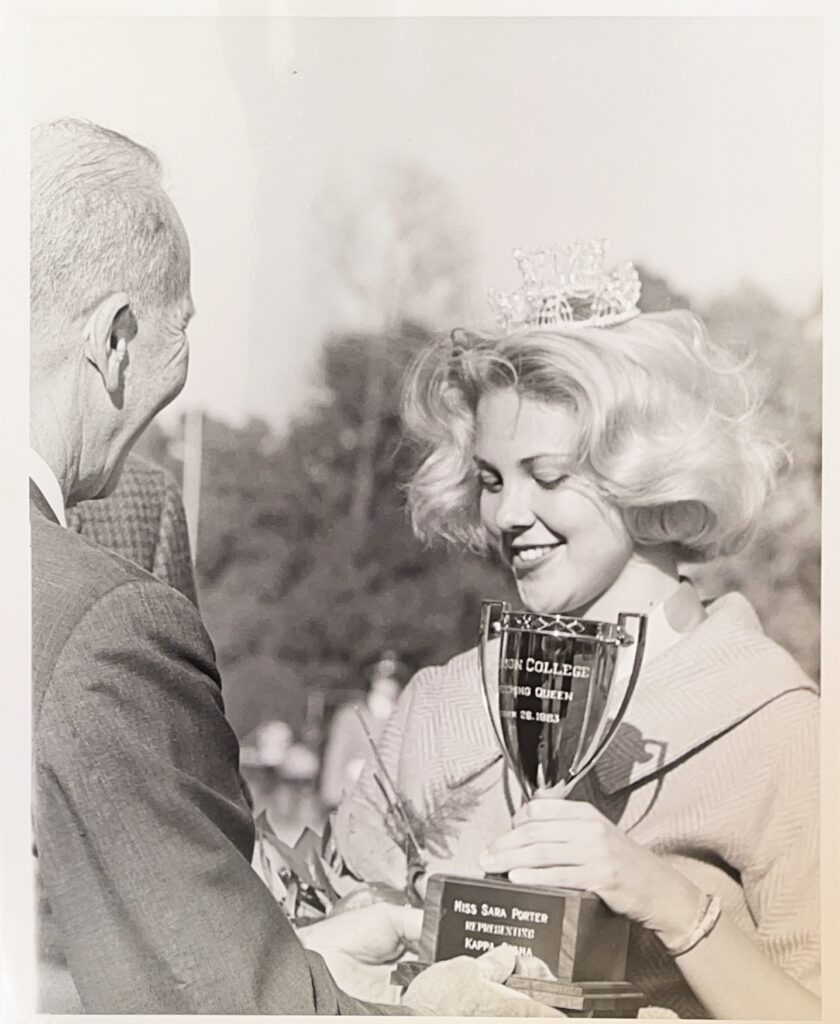
So, who (or what) does the Homecoming Queen represent?
For more than a decade before women could be degree earning students on the Davidson campus, the original Homecoming Queen candidates were female students from different colleges in the area. Initially, it confused me to see how far back in time the Homecoming queen folder extended. I had always assumed a school’s Homecoming Queen was elected based on their great grades, their involvement on campus (and yes, more often than not they just so happen to be conventionally attractive as well); that they represent, at least subjectively, the best that the student body had to offer. But this is a fairly modern interpretation of what the Homecoming Queen competition was originally conceived to be. At least at Davidson, Homecoming Queens were initially crowned not as student representatives, but as feminine figure heads of the wholesome, nostalgic heart of Homecoming itself. In the next blog post, we’ll discuss more about how women were tied into the “wholesomeness” of Davidson Homecoming celebrations starting with the introduction of the Homecoming Queen competition in the midcentury, and what this reveals about the connection between fun, frolics and understandings of gender at Davidson.
Thank you for tuning in, and come back soon for Part 2!
Works Cited: https://davidsonarchivesandspecialcollections.org/archives/encyclopedia/homecoming-results


![Interviewer: How did you end up at the Sunday school [at the mill chapel]?
Margaret Potts: Well I was teaching Sunday school in Davidson Presbyterian Church, early. They wanted me to have the little ones, the two in, whatever hours it was, babysitting more than anything else, in the old church. It was a terrible place to have little children. But anyway, so just through the years, I would teach Sunday school and do things like that, whatever needed to be done. And so, some of the students, some real good students here at Davidson took on the mill project. And they got anybody that they could get to go and help there. And of course, I knew a lot of the people over there, so I was willing to help. (laughter) And until I went off to go to college, and then I had to stop doing that. [Page 26]](https://davidsonarchivesandspecialcollections.org/aroundthed/wp-content/uploads/sites/5/2020/05/transcript_audio154_potts.jpg)

![Margaret Potts: Well, I liked the track meets; oh I loved the track meets. I didn’t miss a single one of those. And in the summertime, we used to come out, and [00:49:00] they would let us -- not complain, if we played. We never did anything terrible. But on this very spot, right here, where this library is, they had this tremendous jungle gym for adults. And what, where they got that, I don’t know whose idea it was to put that thing together. It was metal, big metal things, put together, and it had a ladder that went up two stories and it went all the way across. Now this is was when I was a child. It had -- was hanging down, and a place for you to sit, and you could swing back and forth. It had the most interesting jungle gym I’ve ever seen. They let us play on that. We used to spend hours over here. I think the -- [00:50:00] what was behind? The gym was behind it. And it was in front of the gym.](https://davidsonarchivesandspecialcollections.org/aroundthed/wp-content/uploads/sites/5/2020/05/transcript_audio154_potts2.jpg)


![Interviewer: I know. Asking about, or mentioning Carl reminds me, do you remember a fire in 1949 in Brady’s Alley, (inaudible) –
Mildred Thompson: Oh, yeah, I sure do. I remember that like it was yesterday. Carl was the minister, and Carl was the one that, I’m not positive about this, but I’m pretty sure, he’s the one that started that children’s sermon before church, you know, that called the children down. I think he started that, because I can remember him seeing him come down out of the pulpit, and the little children would just listen, and they’d turn around and say to their parents, “Is that true? Is that true?” When Carl was telling the story.
But anyway, about that, it was almost time for church to be over, and this fire started, and the fire was just blowing, blowing. And of course, everybody was apprehensive, “Where is it?” Well anyway, it was down in that alley; that was pathetic. Those people, I don’t know where they had water, I don’t know what they had, but what they had was pretty bad. And so Carl, after that he went down there and he investigated everything, and he told, he got in the church, and he said, “I refuse to preach in a church where the shadow of the church falls on poverty.” Honey, that afternoon, he took the young people around, it was terrible. Honey, he really turned this place around. [Page 9 -10]](https://davidsonarchivesandspecialcollections.org/aroundthed/wp-content/uploads/sites/5/2020/05/transcript_audio159_thompson.jpg)

![Patricia Sailstad: And I remember the first time we ever had an integrated World Day of Prayer, and I went with Ms. Maude, and it was over at the little Methodist Church that has the log cabin next to it. Oh, gosh. Well, it’s…this is not the black church there. This is the one behind it. It was a white church at the time. But they decided they would have refreshments.
And actually, this was... But it was the first time they’d had black and white together, and after the ceremony we went to their little log cabin, which was right next to it. You’ll see the church; it’s a Methodist church, I think. Now it is a [00:40:00] black church, but it was white at the time. And so there we were (inaudible) standing up. We weren’t sitting down, eating. And Ms. Maude said, “You know, Mrs. Sailstad.” She looked around at the black and the white together, all chatting. She said, “I think this is what heaven must be like.” [Pages 23 – 24]](https://davidsonarchivesandspecialcollections.org/aroundthed/wp-content/uploads/sites/5/2020/05/transcript_audio107_sailstad.jpg)

![¬¬Dolly Hicks: At one time we had a union that picketed, trying to get the union in at the old Davidson Cotton Mill…I remember from down the street cars just -- But we weren’t allowed up there because there was trouble going on up there -- Up at the mill, so you can see it from right where -- back then it looked like a hundred miles, but it’s only, [00:30:00] what, not very far at all, half a block. (laughs) But they did have some over there. Now, [Beatrice?] might could tell you more about that -- but I remember it very distinctly, because we were not very young at that point…’cause I was born in ’25. It would probably be in the early ’30s…But the union or something came in, something they were doing up there, and there was cars, and seems like somebody got hurt.
E.M. Hicks: They had the flying [00:31:00] squadron. Had a flying squadron came out of the North, and they were coming down through the South, and they were going to organize the South. And so they came through Greensboro. Now, this would have been the ’30s. And they came through Greensboro, because Cone Mills was in Greensboro, and we were out -- I lived close to Cone Mills. And this flying squadron came down there, and I remember very well -- you know, it was different back in those days. I was freer to get out and go where I wanted to than most kids my age. And so I wanted to see what was going on. I went out to Cone Mills, [00:32:00] and I could walk out there easily. And I got out there, and the cops wouldn’t let me -- get close. They kept me back. But in those days the cops wore leather leggings. And so these people who were fighting the cops, some of them were the employees, see, and the others were imports, and they’d take an apple and stick a razor blade down in it, you know, and then if you take your fingers and put it on the wrong side of the razor blade so it would be [toward it?], and throw that thing, and when it would hit these guys on the legs, it cut their [00:33:00] leggings. It cut their leggings. It was rough. I mean, it was kind of tough. But anyhow, the cops won, and they left Greensboro, came on down this way. They got to Gastonia. That’s where the big one was. You can find that on the record, because they had machine guns up on the buildings, and they were sitting up there with machine guns. [Pages 66 – 70]](https://davidsonarchivesandspecialcollections.org/aroundthed/wp-content/uploads/sites/5/2020/05/transcript_audio150_hicks.jpg)