
We are definitely in the “dog days of summer” right now, so I thought it might be fun to take a look back at some “dog days” on Davidson’s campus. Staff members, professors, and students have all enjoyed having dog pals on campus!


Blog Site for Davidson College Archives and Special Collections
We are definitely in the “dog days of summer” right now, so I thought it might be fun to take a look back at some “dog days” on Davidson’s campus. Staff members, professors, and students have all enjoyed having dog pals on campus!
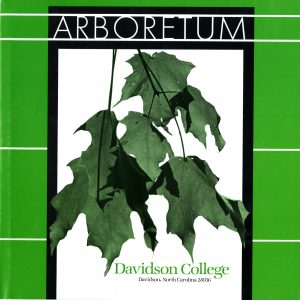
Since 1985, the National Park and Recreation Association (NPRA) has promoted July as National Park and Recreation Month. As part of these efforts, the NPRA encourages people to appreciate the importance of parks and recreational facilities to STEM education, community gathering and engagement, wild life preservation, and public health – among others.
In recognition of this celebration, we invite you to learn more about the Davidson College campus, which is also a nationally recognized and protected working arboretum.
The campus earned this designation in 1982 when then college president Samuel Spencer received a letter from Henry Cathey, the director of the National Arboretum, requesting the grounds of the college be used as a working arboretum. With the addition of a generous donation from the estate of forestry enthusiast Edwin Latimer Douglass, Physical Plant led an aerial photography and mapping project of the campus to facilitate the preservation of the space.

But how did the college’s landscape become so unique that it merited this recognition?
The first mention of intentional grounds planning occurs in the first volume of The Meetings of the Board of Trustees of Davidson College. The minutes for February 28, 1855 state: “A communication was read signed by a few ladies of Davidson College, earnestly requesting the Board to take into consideration the propriety of enclosing the college campus, and a general remodeling of college grounds.”

This is followed up in the Annual Faculty Report of 1860 – 1861 which commented: “During last spring, the students, at the suggestion of the faculty, undertook to set out each a tree for the embellishment of the campus.” By 1869, reports indicated that such plantings would deliberately attempt to replicate the general forestry and botany of the state and region.
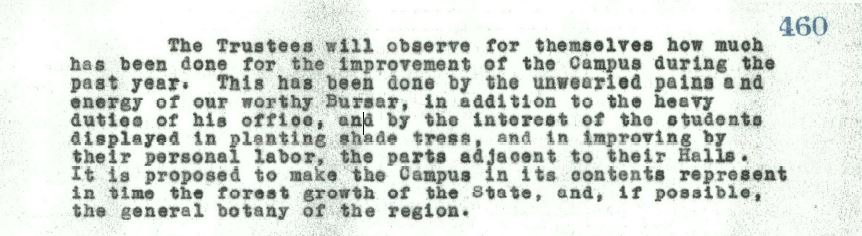
Today, the college arboretum includes five tree species which were extinct on the North American continent sometime between 2 and 50 million years ago. Since their re-planting in Davidson, they have survived several hurricanes, ice storms, and campus landscaping alterations.


So the next time you enjoy the shade provided by our carefully constructed and maintained landscape, stop and look for a small metal plaque where you will find information about the tree’s name and history. Want more information? The Archives holds several copies of the Elm Row Newsletter – a campus publication once dedicated to stories about the college grounds and distributed by campus staff.

Related posts:
25th Anniversary of Hurricane Hugo
Campus Maps
I am a senior Religious Studies major at Davidson College. I am interested in the historical and social components of religious traditions, particularly Christianity, and how religious faith influences one’s worldview. This summer, I have the pleasure of being a Research Assistant for Archives & Special Collections. I am excited about this opportunity to contribute to “Around the D”!
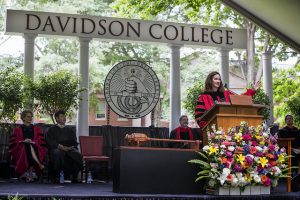
Last weekend, Davidson College held its 181st Commencement. Featured prominently on the commencement stage, on the right of the speaker, is the Davidson College Mace.
Hand-carved by Mr. Jack Ramseur ’31, the Davidson College Mace was presented to the College on January 29, 1988, in honor of the College’s Sesquicentennial Celebration.

In medieval times, maces were traditionally weapons of war. Carried by knights or royal bodyguards, maces were used to protect royalty during processions. By the 14th century, maces assumed more ceremonial functions. The ceremonial mace, usually about four feet in length, survives today as a symbol of authority. Carried by the Chief Marshal in the commencement procession, the Davidson College Mace ceremonially marks the beginning of commencement proceedings.
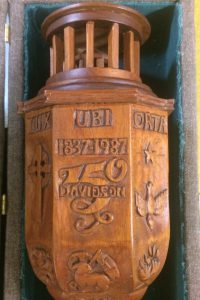
The carving on top of the mace represents the cupola of “Old Chambers,” which was the center of the College’s academic life from the late 1850’s until its destruction by fire in 1921. Below the cupola is the eight-sided base of the dome of the present Chambers building, which was rebuilt in 1931. Forming a circular band just below this base are the words Ne Ultra from the college seal and the words of the college motto Alenda Lux Ubi Orta Libertas (“Let Learning Be Cherished Where Liberty Has Arisen”).
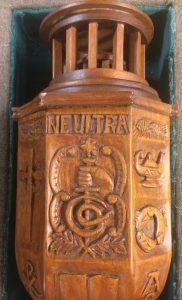
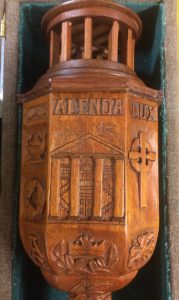
The knop of the mace consists of four wide and four narrow panels. Each wide panel represents symbols of the College, while each narrow panel reflects the College’s historical ties with the Presbyterian Church (USA).

Under the “Orta”, there are three Christian symbols with Presbyterian associations: the star of epiphany, the holy spirit descending in the form of a dove and the burning bush. Davidson’s Presbyterian heritage is further reflected in the mace’s carved crosses.
In yesterday’s issue of the campus newspaper, The Davidsonian, an article by Emma Brentjens ’21 profiled the two women behind the school’s yearbook–Quips and Cranks. Mariah Clarke ‘18 and Hayley Atkins ‘18 are currently co-Editors-in-Chief of the 123 year-old publication. The Quips and Cranks was founded in 1895 and, according to College Archivist DebbieLee Landi, the yearbook originally served as a creative outlet for students, becoming the second campus publication of student work and interests beyond the Davidson Monthly. Since 1895, Quips and Cranks has connected students, archivists and alumni with Davidson College’s past.

While most members of the Davidson community are more than familiar with the college yearbook, Quips and Cranks, they may be less familiar with the origins of its title.
The title comes from a line of Milton’s poem L’Allegro as published in his 1645 anthology, Poems. The poem is a companion to another Milton piece, Il Penseroso. As Jennifer Hickey and Thomas H. Luxon of the John Milton Reading Room at Dartmouth College describe the pairing, “l’allegro is the “happy person who spends an idealized day in the country as a festive evening in the city, il penseroso is “the thoughtful person” whose night is filled with meditative walking in the woods and hours of study in a ‘lonely Towr’.” The poem puts at odds the sensations of mirth and melancholy through the perspectives of a man enjoying the wonders of nature in the countryside and vibrant city life.
Specifically, the yearbook title comes from this passage:
Haste thee nymph, and bring with thee
Jest and youthful Jollity,
Quips and cranks, and wanton wiles,
Nods, and becks, and wreathed smiles,
Such as hang on Hebe’s cheek,
And love to live in dimple sleek;
Sport that wrinkled Care derides,
And Laughter holding both his sides.
Here, Milton is idolizing the joys the nature brings to one who walks within it, such joys indeed are also brought to the students of Davidson College by one another. For those who seek to share some of that joy, digitized copies of the Quips and Cranks dating back to the 1895 edition and as recent as 2011 can be found on the Davidson College Archives & Special Collections website.

The full version of L’Allegro can be found here.
The John Milton Reading Room article on L’Allegro can be found here.
The article from The Davidsonian can be founds here.
This is part two of a two-part post.
Interestingly, this back-and-forth surrounding the black fraternity debate in 1989 was covered by a writer for the Charlotte Observer, Ricki Morrell. In her coverage, she mentions opposition within Davidson’s fraternities and dormitories against the idea of a black fraternity on campus.[7] In a short column commenting on Morrell’s piece, President of Patterson Court Council Bennett Cardwell sought to provide a clearer picture of where the Davidson student body generally was in terms of the debate. In a piece titled “Story Is One-Sided,” Cardwell identified Tom Moore as “a random senior” dissenter whose opinions did not “in any way represent those of the student body in general.”[8] Cardwell assured that the opposition to diversifying Patterson Court was much smaller than Morrell led everyone to believe; he even stated that many white students were in favor of the idea of a black fraternity.[9] Second, Cardwell rejected the notion that there were “white fraternities” at Davidson, assuring his audience that there were black members in the fraternities on campus.[10] At the time, the members in Davidson’s six fraternities comprised about sixty percent of the student body. If Cardwell was the voice of reason in this debate, then given the fact that the interest in diversifying Patterson Court persisted as time went on, why did it take until 2003 to bring any black fraternity to Davidson College?[11] Aside from later concerns of sustainability from Alpha Phi Alpha, Inc., the college still holds a large portion of that responsibility.[12] Some within the Davidson College community continued and continue to faithfully adhere to the inclusivity argument against diversification, reinforcing Davidson’s culture of color-blindness. Historically, when that argument did not work, some attempted to augment it by expressing concerns of the further fragmentation of the Davidson College community. These arguments lend themselves to the notion of minimal representation. If color-blindness has been Davidson’s modus operandi, the goal of minimal representation is Davidson’s subconscious impetus.

Minimal representation in this context refers to Davidson College’s tendency to strive for the bare minimum in terms of social representation so as to diversify and simultaneously be able to maintain color-blind tendencies as the institution evolves. That way, the college can comfortably fight for change and minimize social backlash on campus. The push for minimal representation is especially evident given Davidson’s decision to establish the BSC so early in the institution’s history of diversification, yet struggle with the diversification of Patterson Court for such a long time. The reluctance to establish any sorority on campus primarily due to the presence of eating houses also illuminates the desire for minimal representation. In a letter dated December 1,1997 and addressed to the President of Davidson College at the time, Robert F. Vagt, several members of the Executive Committee expressed why the college should not allow any sororities on campus. The committee stated their arguments clearly: sororities are organized around social exclusivity, eating houses are an inclusive system, and academic life would be adversely affected.[13] At this time, all of Davidson’s Patterson Court institutions were predominantly white and no sororities existed. The Executive Committee’s letter exposes the same trope evident in the 1989 black fraternity debate: the inclusivity argument, and other arguments to fall back on should the former fall through. Davidson reveals itself to be suspicious of diverse social forms and exposes its affinity for the status quo.

A status quo is not an inherently bad thing. However, when we consider Davidson College’s constant need and desire for structural improvement, using color-blind materials is not the way to go. In fact, it is a contradiction. Color-blindness has to be removed from Davidson’s toolbox if we are to improve this institution. If Davidson directly or indirectly utilizes blindness as a tool for its enhancement, nothing is actually ameliorated, hence the status quo. Some at Davidson College still pride themselves on their color-blind ideologies, and other types of blindness as well. Color-blind arguments coupled with minimal representation kept black fraternities off of Davidson’s campus until the early to mid 2000’s. The 1989 black fraternity debate and later opposition against sororities are prime examples of the resilience color-blind ideologies have had within the Davidson College community. That is to say that Davidson College, as the institution exists now, has been compromised, just like the United States. Nevertheless, Davidson’s flaws are to be neither accepted nor celebrated unless the status quo is something we enjoy seeing.
Bibliography, Part Two
[7] Ricki Morrell. “Black Davidson Students Push For Black Fraternity,” The Charlotte Observer, Article, November 21, 1989.
[8] Bennett S. Cardwell, “The Story Is One-Sided,” 1989.
[9] Ibid.
[10] Ibid.
[11] Ricki Morrell. “Black Davidson Students Push For Black Fraternity,” November 21, 1989.
[12] Lincoln Davidson, “Alpha Phi Alpha marks 10 years at Davidson College,” November 3, 2013.
[13] Executive Committee, “Sororities at Davidson College,” Letter to College President, December 1, 1997.
Guest Blogger: Niara Webb, Class of 2020
 Last night’s 9th Annual Ghosts in the Library event was a smashing success! A record number of Davidsonians poured into the Rare Book Room to hear spooky stories by (LED) candlelight.

Dr. Andrew Leslie of the Communications Department, who also happens to have been a professional storyteller for 20 years, started off the night. He told the tale of The Old Man and Tailypo, a story from North American folklore of an old hermit who is terrorized by a mysterious creature whose hunt for his missing tail leads to the old hermit. Next up was Lee Kromer ’21, who told an original tale of a man who was followed across continents by a murderer escaped from a Gulag prison camp. Shelby Cline ’20, recalled an experience with a mysterious supernatural being during a dark, early morning rowing practice. Cameron Rankin ’21 read the listeners a classic New England tale of a haunted house in which the owner had been buried beneath the hearth. Finally, Dr. Leslie shared one more story and the winner of the six-word horror story was announced: Hannah Lieberman ’18!
Hannah wrote, “But the paper was due… yesterday!!!” A Davidson-themed scary story to round off the evening.
Guests who survived the night of spooky tales were thanked with bags full of chocolates, Halloween candies, and homemade chocolate chip cookies. Thank you to all who attended and we wish you a very happy Halloween!
FOILING FAKE NEWS: A MULTIDISCIPLINARY DISCUSSION ON NAVIGATING THE MEDIA
THURSDAY, SEPTEMBER 14, 2017 – 11:05 AM – 12:05 PM
Fake news has become a buzzword that can mean many things to many people. But what does it mean for us at Davidson? How prepared are students to identify fake news and navigate today’s media? How might a liberal arts approach inform our understanding of fake news and help us avoid being taken in by it? Join us for a panel discussion to explore these questions. Librarians will present data about incoming Davidson students’ ability to evaluate media sources and faculty members will bring their unique disciplinary training to bear on the issue of fake news.
LOCATION
Knobloch Campus Center Alvarez- Smith 900 Room
There have been a number of college humor magazines in Davidson’s history: Scripts and Pranks, The David’s Onion, The Davidphonian, The Devoidsonian and The Yowl; although, The Yowl is the only edition to be reawakened in the twenty-first century. In 2004, it reappeared as a column in “The Davidsonian”, bringing its version of the news to provide entertainment to the Davidson community. The final issue of the 2016-2017 academic term proclaimed, “This Issue Brought to You By: Undying Cynicism” and provided “The Yowl’s Year in Review.” The September 7, 2017 issue, in keeping with the theme of fake news, stated, “This Issue Brought To You By: A Gross Violation of Journalistic Integrity.”
A recent donation from alumnus and environmental ethics leader Holmes Rolton III (class of 1953) raised the question of Davidson’s engagement with environmental issues including Earth Day.

The annual celebrations of Earth Day began in 1970 and a few Davidson students made sure the college joined in that first year.

The students paired with the Union cafeteria to create a display of paper cups and litter, they also helped with trash clean up in town and passed out flyers encouraging people to drive their cars less. Their efforts met with some resistance. One faculty member declined to purchase a 40 cent bumper sticker (which said “Did you thank a green plant today?”) noting that he’d rather support the anti-war cause. Another questioned the rationale of putting anti-pollution stickers on polluting cars. Undaunted, the students planned an environmental awareness teach-in with faculty and Congressman Nick Galifinakas.
The initial enthusiasm appears to have faded and in the next decade, Spring Frolics, Convocations, International Festivals, Easter breaks, and Alumni Weekends pushed Earth Day off campus calendars. Concerns over environmental issues grew again in the late 1980s, supported by Ruth Pittard in her role as program coordinator for the college union. While not held on the official date, a 4-day Environmental Awareness Weekend was held April 5-8, 1989 with films, speakers and a repetition of the inaugural Earth Day’s display of campus trash.

With the formation of the Environmental Action Coalition (EAC) as a student organization, Earth Day returned to Davidson. Instead of losing out to competing events, the Earth Day organizers often joined forces with other groups to combine their events with Frolics and Community Service’s Into the Streets programming


In the late nineties, Earth Day went solo but with a twist – other campus organizations began to participate. The 1999 celebration had student organizations and town businesses setting up booths. One unnamed group returned to the theme of discouraging car use asking people to stop driving for one week. Warner Hall helped people sign up to avoid junk mail. It also expanded into weeks and even Earth Month in 2005.

In 2002, the Physical Plant workers weighed in with an information ad in the Davidsonian.

In the same issue of the Davidson, an editorial “Earth Day + Fun = Kegs” raised the question of whether having kegs would be a more environmentally friendly approach to reduce Patterson Court trash.
In 2005, Earth Day plus fun meant the first Green Ball hosted jointly by the EAC and the Davidson Lands Conservancy.

The inaugural Green Ball, featuring contra dancing and a silent auction, raised over $5000. Still a popular event, the 2016 ball raised
The college proclaimed 2009 the Year of Sustainability, with a special Green Week happening in February rather than April. In 2012, Earth Day became part of Greenstock with information booths and student performers taking over the Union atrium. In 2017, EarthDay will spread beyond the campus as alumni chapters across the country join volunteer days for beach cleanups, recycling electronics, prepping community gardens and more.
Late December and early January are popular times for open house events. Time was at Davidson when open house meant not a holiday party but student-faculty gatherings.
Anne Sampson recalled inviting students to “dinner or to supper and play “Authors” afterwards–We got a little organ and they came Sunday evenings to sing from supper time till Church– In this way we wanted every boy in College at least once or twice a year.” From these informal evenings in the 1880s, a pattern later emerged of students calling on faculty on Sunday evenings after the college’s weekly vesper service. Faculty wives would prepare light snacks and students would wind their way to professors’ home for a time of light conversation.
By 1946, the practice had been formalized and written on the weekly vespers pew sheet:

The last item on the program reads: The following will be “At Home” to the students after the service: Professors Reid, Shewmake, Thies, Vowles, Watts, Wood, Shepard, Davidson. Weekly at homes eventually shifted to faculty being divided into groups with each group assigned a specific Sunday of the month to play host in their homes. One group would always host on the first Sunday, another on the second, etc.
In the spring of 1966, the college’s social fraternities took tried an experiment with open houses. They offered to host faculty once a month on a Sunday evening. Three fraternities opened each month and sent invited specific faculty. The Inter-Fraternity Council sent out a detailed memo:

The memo explained: During the second semester the social fraternities would like to reciprocate your hospitality by hold open houses once a month on the fraternity court in addition the regularly scheduled open houses after vespers on Sunday night. Three of the fraternity houses will be open at the same time, and you and your wives will be invited to attend at least once during the semester. All interested students will be invited as well.
Faculty were also informed that they could visit all three of the open houses on their Sunday evening but were asked “that you start at the house which sent you an invitation.”

The project worked for that semester but the following fall, vesper attendance became optional and open house attendance dropped considerably as well. A Special Committee on Religion addressed the issue by recommending that “for November, December, and January faculty members wishing to entertain students should personally extend the invitation to classes or other interest groups.” And further, Sundays were optional, “Rather than on any designated day the visits will be at times mutually convenient to the professor and the students he has invited.” The committee offered yet another innovation–modest financial support of up to $25 funded through the Dean of Students.
A vestige of this tradition remains during commencements with academic departments hosting students and their families and, of course, the practice of faculty and staff hosting students in their homes throughout each semester.
Like most Americans, Davidson students were aware of wars in East Asia and Europe but their involvement was limited. On November 17, 1941, the YMCA announced that the annual Gift Fund project would be directed at refugees and war prisoners. Specifically, the gift fund would be purchasing Bibles to be sent to China, to prisoners in concentration camps in Germany, and to the US Navy. Using the theme of Let Use Share Our Faith, YMCA president Jim Owens stressed the need for “fighting hate and suffering with our strongest weapon, the Bible.”


College president John Cunningham and town mayor (and Latin professor) Ernest Beaty endorsed the gift fund project with Cunningham saying “I can scarcely think of any undertaking which holds the possibility of being more fruitful” and Beaty declaring “The best defense against evil in the present age is Truth as expressed through the Bible.”
Headlines for the December 11, 1941 Davidsonian –the first issue after the bombing of Pearl Harbor — focused on the latest Red and Black Masquers play, the annual Vesper service, and the cost of dance bands. The only reference to war came in one article about the ROTC honorary Scabbard and Blade.

Below the fold, this issue featured a photograph of the Davidson Bibles arriving at the USS North Carolina.

More news about the war appeared on page 2, with the text of President Cunningham’s chapel speech from December 5th:

Cunningham urged restraint, noting that he was in seminary in 1917 at the outbreak of WWI, he told current students
I wish to express a word of caution today against panic and hysteria at this time. It is possible that some few students may feel that they are called to turn aside from their preparation and hasten into the military service of the country. My prediction is that there is plenty of time yet for that service. The word which I wish to stress, particularly to you today is that you are now engaged in a fundamental defense task. You must beware that you do not throw away an opportunity which has been denied approximately 97 per cent of young men– those who do not get to college. We must look further than winning a war. Winning the peace is going to be even more important.
A student editorial on the same page focused more on the American sense of humor in relation to Japanese culture.

The first effects of the war on campus appear in the January 29, 1942 issue with articles on changes in physical education, the introduction of summer classes, changes in ROTC staff and the first Red Cross canvas. Other headlines show life as usual with mid-winters dances and Presbyterian student conferences.

Back on page 3 of this issue, the college library gets credit for collecting books (other than Bibles) for the military.

The first war bonds cartoons appeared in the February 5th issue. One on the editorial page.

And one on page five next to an article on draft deferment policies:

The Trustees began to address war-related issues later in February.

Noticeably absent are any articles on international events. The student paper has rarely covered much in the way of national or international news and in the initial weeks after Pearl Harbor that focus didn’t change. The first reference to Davidson alumni in the military appeared in the February 26, 1942 issue.

A few weeks later, the Davidsonian reported on the civilian defense as the college began organizing air raid and fire watchers. Davidson was an unlikely target but we were prepared.

The war became more prevalent –even without wire stories from the front– when advertisers started using military themes.
