Hi everyone my name is Emily Lauher. I graduated with a Bachelor’s Degree in History from the University of North Carolina at Asheville. I am a 2017 volunteer at Davidson College organizing the personal papers of Anne Stewart Higham, an adventurous world traveler.
Davidson College received this collection from one of Anne Higham’s granddaughters, Dr. Carol Higham. Dr. Higham is a professor of Native American History at the University of North Carolina at Charlotte. She has also worked as an adjunct professor at Davidson College. She first approached Jan Blodgett, College Archivist, regarding the personal papers belonging to Anne Higham.
Anne Stewart Higham
Anne Higham traveled extensively between 1940 and 1969 to Europe, North America, the Middle East, Asia, and Africa.
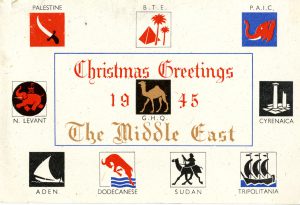
1945 Christmas Greeting when Anne Higham traveled throughout the Middle East.
During that time, she surrendered her American citizenship and became a British citizen (later requesting a return to American citizenship). Somehow, during those transactions, her birth year was also altered, making her five years younger on a return trip.
Working as an Army lecturer for the British Army, she first toured Royal Air Force stations in the Middle East and in 1946, began a tour of India and Africa. The correspondence in the collection discusses her lecture topics such as the history of Britain, conditions in Africa, and the Middle East. She also gave lectures on British women and the British war effort during World War II.
Anne Higham, United Nations lecturer
Dr. Carol Higham will be sharing an accretion to this collection, and I am hoping for copies of Anne Higham’s lectures and research notes to add to the photographs, negatives, correspondence and other materials in the collection. I am also hoping to learn more about Anne Higham’s life in these international locations and her relationship with her brother and son who served in the military during World Wars I and II.
1903 Souvenir Album cover1903 Souvenir Album, Campus View Looking West from Chambers
Every day I walk the path from Chambers to Main Street, past Oak and Elm, Phi and Eu. The path is incredibly familiar, and thus it was a surprise to realize that the photograph of a tree lined path from a 1903 view book is the same walk, only missing the benches, well, and the bricks paving the path. Phi sits at the end of the path, almost blocked by trees. As other photos in the view book show, the only change in Phi and Eu is the landscaping around them. Though the view book exclusively documents the heart of Davidson’s campus, Phi and Eu are the only buildings in this view book to remain completely unchanged. The original Chambers still stood in 1903, and would for eighteen more years, and Rumple and Martin were replaced by new buildings serving the same purpose. Some of the reference points used in the view book no longer even exist. Shearer was torn down in 1960, to be replaced by Cunningham, and the ivy-covered Morrison Hall came down in 1945.
1903 Souvenir Album, Hall of the Philanthropic Society1903 Souvenir Album, Hall of the Eumenean Society1903 Souvenir Album, Shearer-Biblical Hall – Erected on the Site of the “Old Chapel”1903 Souvenir Album, The New Dormitory Building
The view book boasts of recent improvements to the college. Among other changes, within the last four years, Shearer, the original Martin, and a so far unnamed new dormitory were built. The dormitory, later dubbed Rumple, was well equipped, with running hot and cold water and radiator heating. It was also wired for electric lights, as the college planned to soon build a power plant. Despite the new building, the college was having a housing crisis, and the calls for enough funds to build another dorm were beginning to grow desperate. Rumple sat where Little is currently located, and I found it interesting to compare the two buildings. Rumple was large at the time, housing sixty students, while Little holds seventy-five. Both buildings follow the same aesthetic of other dorms along dorm row, but while Rumple started the look, Little merely matched the buildings already built. Chambers also needed to be renovated—after nearly fifty years of use, the building could use some work.
1903 Souvenir Album, The Chambers Building – Erected in 1857
My attention kept getting drawn back to the images of the original Chambers. The tallest building on campus poked over the treetops, appearing in several shots. Before looking at this view book, I had never seen a picture of Old Chambers, despite hearing many campus stories about it. In one of the pictures, you can see the large columns that still haunt the lawn in front of the present Chambers. The building is different in some ways from present Chambers, smaller and not quite as cohesive, but the buildings still look similar. Then and now, Chambers remains the center of campus, even as the building itself is destroyed and rebuilt.
This week’s post is written by Vera Shulman ’15, a student assistant at Davidson College’s E.H. Little Library. She wrote this entry on August 22, 2014.
This summer I worked as a library information desk assistant. My days were split between staffing the desk, shifting the Library of Congress stacks in the basement, and completing various tasks in the Archives & Special Collections. My archives duties ranged from perusing local newspapers for filing (in which I was immersed in the excitement and ultimate disappointment of 2008’s college basketball championship) to transcribing oral interviews. I re-housed and filed massive decades-old maps (with help from student coworker Ellyson) and skimmed through Davidson’s 1914-1919 yearbooks and weekly newspapers for references to WWI.
The latter task interested me thoroughly due to the very polite and dry humor. By modern standards, though, a slim but noticeable portion of that writing was insensitive to concerns with race and gender. During that time, Davidson College became preoccupied with supporting the national war effort with Liberty Loans and stamps and by training students in the freshly formed Student Army Training Corps (which following the war, turned into our current ROTC).
My favorite tasks, though, were the ones that played to my strengths in visual media. I had a whole set of these responsibilities that all boil down to scanning, editing, and uploading an image for use on the archives website. I processed Davidson’s 2010, 2011, and 2012 yearbooks (called Quips and Cranks); dozens of recent school newspapers (named The Davidsonian), and old editions of July-born author’s works.
Because the yearbooks are recent, working with Quips and Cranks allowed me to reminisce about friends and events (and grimace in the case of ex-boyfriends) and better associate formerly unknown peers’ faces with their names. The editing required for the yearbook scanning is very similar to the photo editing I do for leisure, so I actively enjoyed cropping and re-angling those pages. I didn’t form a solid connection with The Davidsonian because I used a closed scanner which didn’t allow me to browse as I scanned.
Trail of a bookworm.
The old editions of July-born author’s works are beautiful. The pages were thick and a few grazed on by literal book worms. Some of the covers were marbled in a way that seemed similar to a technique I’d used in primary school for my own book covers. Some illustrations were cartoon, in some the strokes were sparse, and others were both intricate and realistic.
This week’s post is written by Emma Kenney ’15, a student assistant at Davidson College’s E.H. Little Library. She wrote this entry on August 22, 2014.
While working at the E. H. Little library for the summer, I had the opportunity to be involved in a variety of projects and departments. I was able to interact with patrons while working at the circulation desk, get further acquainted with the Library of Congress cataloging system while participating in a large shifting project, and, most relevant to this blog, I was lucky enough to be able to spend part of my time in the Archives & Special Collections.
The projects I worked on varied from week to week, so I will refrain from describing every task I performed. Instead, I will summarize my archival activity during my last week at the library as a student employee.
Throughout most of the summer, I have spent my allotted time in Archives working to digitize course syllabi so that these documents could be made available online. Having finally succeeded in un-stapling, scanning, re-stapling, saving .jpegs to a new folder, combining images into a single .pdf, and moving all .pdf’s to a separate folder every last syllabus in my box, I was finally ready to put these syllabi where they belonged: in an online database, where they could one day be accessed by anyone on campus who needs them. While I had been pleased and excited to see my stack labeled ‘finished’ grow steadily, it was even more enjoyable to see that the time and effort I had spent digitizing these documents had made it possible to change the accessibility of these syllabi. This how I spent my shift on my last Monday, working to upload and enter the metadata for as many syllabi as I could.
The following day I was given a list of items by the Archives staff. With new student orientation beginning and the start of classes around the corner, I was asked to locate and pull certain volumes from the Rare Book Room so that they could be put on display for the perusal of our new students. This list included, among other items, ancient cuneiform tablets, volumes of Diderot’s Encyclopedie, and an incunabula entitled Life of St. Thomas a Becket. This list lasted me through the next few days, and each item I pulled was fascinating and beautiful in its own way.
Life of St. Thomas a Becket, printed in Paris in 1495 – one of only six known copies in the world!
The incunable was lovely, and somewhat disconcerting. Given the age of the text (its printing date is listed as 1495), I was concerned that handling the volume would cause it to crumble and become ruined, and was therefore very wary of touching it, let alone moving it from its location on the shelf. But upon further inspection, the craftsmanship proved to be remarkable. I could see where the leaves had been sewn into the spine, and the thickness of the vellum encouraged me to be comfortable perusing the text. It is a beautiful volume, and one I was very glad to have been able to see and handle.
On the topic of beautiful volumes, Diderot’s Encyclopedie certainly outshines most texts I’ve interacted with. These first editions are lovely and quite sizable, dating to between 1751 and 1788. The encyclopedia volumes are paired with planche volumes, which are full of incredibly intricate printed illustrations. It is clear that the amount of effort that must have gone into engraving each plate was sizable, and the resulting prints are breathtaking.
Illustration of a porcupine from Diderot’s Encyclopedie.
As an Anthropology major, I was intrigued the most by the cuneiform tablets. Dating as far back as about 2350 B.C. with provenances located in the ancient Mesopotamian area, these artifacts are intricately carved and fascinating. While I have no way of understanding the exact meanings of the characters, simply being able to handle and examine these artifacts was such an educational experience. Short summaries of the inscriptions are available for each tablet for those who are interested in knowing roughly what has been recorded on the tablets, but a simple English translation could not compete with the beauty and intricacy of the carvings. Photographs could not do these tablets (nor any of the rare books) any justice, and these carved stones provided a fascinating comparison to the forms of writing that I interact with on a regular basis.
This final week in the Archives, between the culmination of my syllabus project and the explorations of the Rare Book Room, has been one ‘for the books.’ While all of the projects I have worked on have challenged and intrigued me in different ways, I would have to say that the projects of this final week have been the most exciting for me, providing a perfect end to a fantastic summer position.
This week’s post is written by Dr. Anelise H. Shrout, a Visiting Assistant Professor in the Department of History.
In my perfect world, all history classes would be taught using archival collections, and all history students would learn not just what historians do, but how we do it. This year, I’ve had the pleasure of teaching historical practice through Davidson’s own archives – and particularly through the Davidson College Map Collection and the William Patterson Cumming Map Collection.
1983-84 campus map, with the locations of shrubs marked
On the first day of classes this semester, (and during Caitlin’s “A Week in the life of an Archivist”) I asked students in my environmental history class to describe the most natural space on campus. Most mentioned the trees, some talked about the cross country trail, and one mentioned the squirrels, but the overall consensus was that plants and animals are natural, and buildings are not. At the end of class that day, we walked over to the college archives, and spent the remaining time looking at old maps and pictures of the campus. We perused a tree map from 1962 and a “shrub survey” from 1984 that meticulously noted the position of the plants that make up Davidson’s “natural” environment. We saw pictures of the “ghost of Old Chambers” and images of the campus entirely devoid of trees. For me, the most interesting images were the might-have-been maps, which showed proposed, but never realized, alterations to the campus landscape (I’m still hoping that they decide to install the once-planned reflecting pool in front of Chambers!)
The still-visible foundation of Old Chambers
Pedagogically, this exercise was meant to complicate the rigid divide between “natural” and “unnatural” space, but I think that there was also something useful in showing students documents that shape their everyday lives. Holding the actual maps that dictated which elms be placed in once place, which bushes in another, and how the two trees I’ve often seen supporting hammocks on the weekend got where they are, remind us of Davidson College’s long history, and the generations of people – both students and campus workers – who worked to shape Davidson’s environment as it is today.
An original plan for Chambers
Maps – albeit much older ones – animated my second archival trip of the semester. Students in my survey of U.S. history to 1877 are required to write primary source analyses; the first of which must draw from the William Patterson Cumming map collection. Unlike the campus physical plant maps, these are digitized, and I probably could have run the entire assignment from my classroom in Chambers, reading digitized descriptions and zooming in and out of the Luna map browser.
But, despite digital availability, there is, again, something unique about seeing, and touching the artifacts that you are studying. By looking at them up-close, my HIS 141 students were able to examine the differences between maps made for ostentatious public display, and those made for everyday use. They were able to see the hand water coloring on Emanuel Bowen’s New Map of Georgiaand the meticulously drafted (though geographically inaccurate) mountains on Jaques Bellin’s map of North Carolina.
Bellin’s “La Caroline dans l’Amerique Septentrionale Suivant les Cartes Angloises,” 1764
Going to the archives lays bare one part of what historians do, but perhaps most importantly, these trips to view and touch these objects remind us that the artifacts we often see reproduced in books or in excerpt are real objects, used by real people – and in the cases of some of the maps I have the privilege of teaching with, used to explore North Carolina over two hundred and fifty years ago.